
As of April 7, new regulations on smart working and workplace safety have come into force in Italy, introducing a significant update to employers’ information obligations. This marks an important step in reinforcing a now well-established principle: remote work is no longer an emergency solution, but a structured working model that requires clear rules, defined responsibilities and appropriate tools.
Smart working and safety: what actually changes
The new provisions focus primarily on the information regarding risks associated with remote work. Employers are now required to provide workers—and employee safety representatives—with clear, updated and consistent documentation aligned with the actual working conditions.
This means moving beyond generic or standardized approaches toward a more concrete assessment of the environments where work takes place: homes, shared spaces, coworking environments. Each context presents specific risks that must be considered, both in terms of posture and equipment use.
Safety, therefore, is no longer confined to the physical office, but extends to every place where work happens.
Ergonomics and prevention: the role of the workspace
Within this framework, ergonomics plays a central role. The new rules strengthen the focus on risks related to incorrect posture, inadequate seating and environments not designed for prolonged use.
A frequently underestimated aspect is that, in domestic settings, workers tend to adapt to available spaces rather than operate in optimal conditions. Improvised desks, unsuitable chairs, poor lighting—these factors can negatively affect both health and productivity over time.
It becomes essential to rethink domestic and hybrid workspaces using the same design principles applied to professional environments. This does not mean replicating an office, but ensuring minimum standards of comfort, support and functionality.
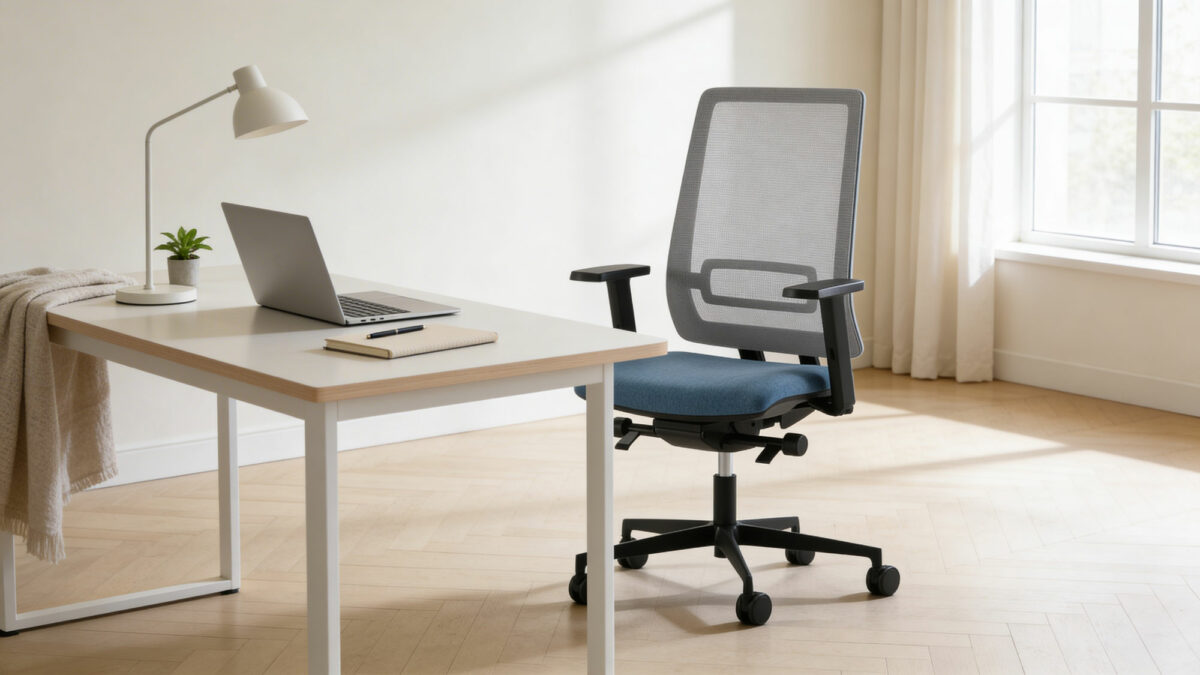
In this context, ergonomic task seating represents one of the most effective tools for prevention. Adjustable systems, proper lumbar support, synchronized mechanisms and customization options allow the chair to adapt to the user, reducing fatigue and the risk of musculoskeletal disorders.
An important aspect, often required in both regulatory and design contexts, concerns compliance with European standards. Many Sitlosophy task chairs are certified according to EN 1335 (Mirai, Spark), a technical standard that defines dimensional, safety and ergonomic requirements for office seating. This certification provides a concrete guarantee of design quality and suitability for prolonged use, both in corporate environments and in remote working setups.
From individual workstations to shared environments
The new provisions do not concern remote work alone, but are part of a broader transformation of the workplace. Contemporary offices are increasingly hybrid, combining in-person and remote activities, individual tasks and collaborative moments.
In this scenario, workspace design becomes strategic. It is no longer enough to provide ergonomic individual workstations; it is necessary to create environments that support concentration, interaction and overall well-being.
Modular seating systems, for example, make it possible to configure informal areas dedicated to conversation, while maintaining high levels of comfort. High backrests, flexible configurations and customization options help create protected micro-environments, ideal for quick meetings or collaborative work.
At the same time, task chairs must integrate seamlessly with the architecture of the space, supporting different modes of use without compromising ergonomic quality.
Information, responsibility and design
The new smart working regulations introduce a shift in perspective: safety is no longer just a formal requirement, but an ongoing process involving information, awareness and design.
Providing proper information also means enabling workers to recognize optimal conditions for performing their tasks. However, for this to be effective, tools and environments must be designed coherently.
In other words, the quality of the workspace becomes an integral part of business strategy, alongside processes and technologies.
Towards a new balance of work
The regulatory evolution confirms an ongoing direction: work is becoming less tied to a physical location and more dependent on a system of conditions that must be ensured, wherever it takes place.
This implies greater attention to workspace design, furniture selection and the ability to create flexible, adaptable and safe environments.
Certified ergonomic seating, modular systems and integrated design solutions are no longer secondary elements, but essential tools to support people’s well-being and the overall quality of work.
In this context, design means taking responsibility: creating environments that not only meet functional and aesthetic requirements, but also actively contribute to health, safety and productivity.


