
The design of contemporary workspaces requires an increasingly flexible approach, capable of responding to different and constantly evolving ways of working. Shared offices, open spaces, meeting areas, focus zones and executive offices now coexist within a single design ecosystem, where comfort, functionality and visual identity must interact coherently.
Within this context, modular systems, task office chairs and executive armchairs become central elements of the project—not simply pieces of furniture, but true working tools.
Shared offices and design flexibility
Shared offices are now a well-established typology, adopted both in corporate environments and in hybrid and collaborative workplaces. Open spaces encourage interaction, exchange and operational efficiency, but they require carefully designed solutions to ensure ergonomics, acoustic comfort and a high-quality daily experience.
In these settings, the choice of task office chairs without headrests responds to a specific need: providing support and comfort for prolonged use, while maintaining a light, functional aesthetic that can be easily integrated into modular shared workstation systems.
Seating solutions such as Spark and Nami interpret this approach through an essential, contemporary design language, conceived for dynamic environments where flexibility is a primary design value. Lightweight structures, balanced proportions and careful ergonomic design make these solutions suitable for operational offices, meeting rooms and collective work areas.
Differentiating spaces: operational and executive areas
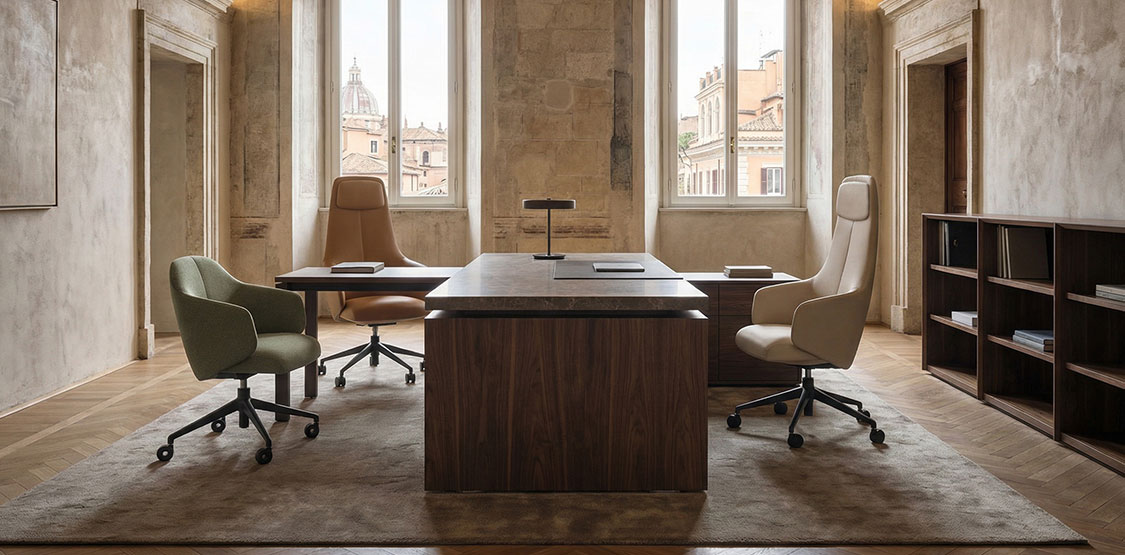
Alongside shared environments, office projects often include more private spaces dedicated to concentration, representation or executive management. Glass-enclosed offices, managerial studios and executive areas require a different interpretation of seating.
Executive armchairs, often equipped with headrests, respond to advanced comfort requirements and enhanced ergonomic support, while also playing a symbolic role in defining the space. In these environments, seating becomes an integral part of the office’s identity, conveying authority, attention to well-being and overall project quality.
Solutions such as Quinta express this balance between function and image: a collection that approaches seating with a stronger character, designed for executive environments, representative meeting rooms and contexts where design directly reflects the role of the space.
Design products as project tools
In the design of workspaces, design products are not isolated elements, but components of a broader system. Seating, tables, modular systems and accessories must be selected according to use, context and spatial relationships.
The Sitlosophy Inspiration Book was created precisely with this goal: to offer a transversal interpretation of the collections through images set in real scenarios. Meeting, sharing, working, waiting and interaction become concrete contexts in which to observe how task office chairs and executive armchairs fit into different layouts, engaging in dialogue with architecture and functional requirements.
It is not a technical catalogue, but a project support tool—useful for evaluating proportions, combinations, configurations and possible interpretations of space.
A resource for architects and designers
For architects and interior designers, having clear visual references is essential in the early concept stages and during discussions with clients. The Sitlosophy Inspiration Book is conceived as a visual guide designed to support the design process, offering concrete examples of product applications in shared offices, executive spaces and contemporary work environments.
An invitation to imagine space not as a collection of individual elements, but as a coherent system in which ergonomics, modularity and design work together to enhance the quality of everyday work.


