

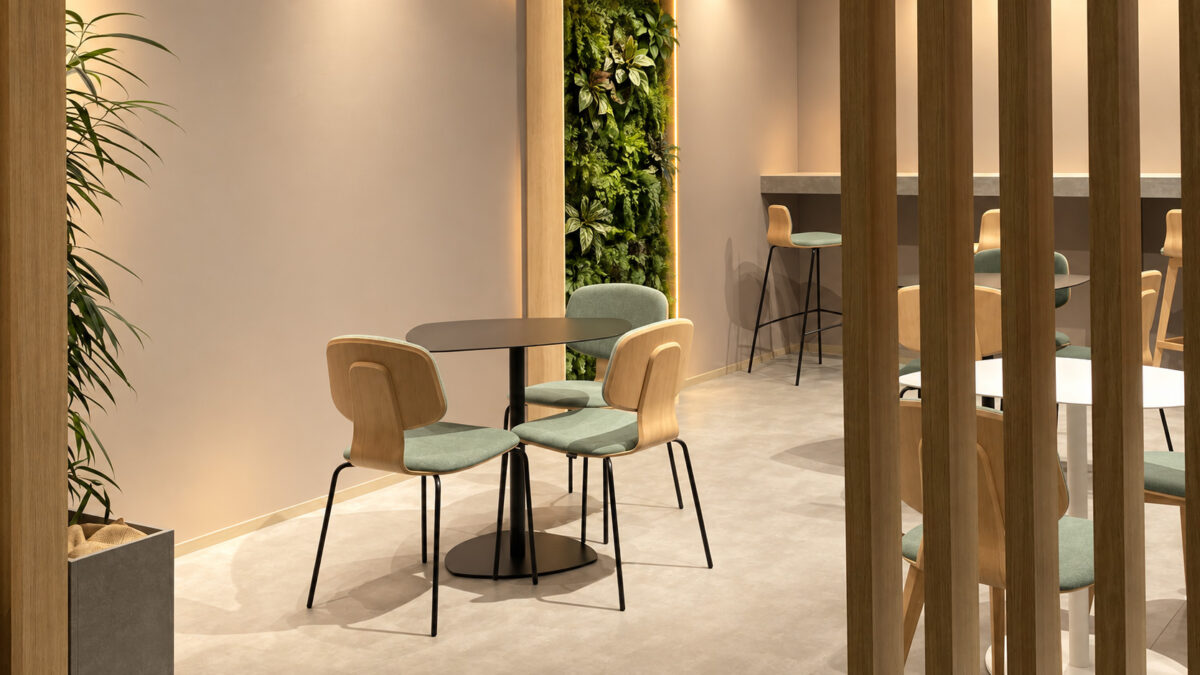
FSC® Forest Week 2026 takes place from 21 to 27 September and is the Forest Stewardship Council®’s annual global campaign dedicated to responsible forest management. For those who design and supply office spaces, it is a valuable opportunity to clarify a topic that often appears in project specifications but is rarely fully understood: what does FSC® certification actually guarantee when it comes to the wood used in a chair, and what does it not guarantee?
FSC® Forest Week 2026: why it matters to workplace designers
FSC® Forest Week was created to highlight the role of forests in tackling climate change and biodiversity loss, encouraging companies and professionals to take “one concrete action”. In the contract sector, this action has a significant impact: the choices made by a designer or dealer are multiplied across dozens or even hundreds of chairs in each project. Correctly specifying a product made with certified wood – and understanding exactly what is being certified – is therefore a meaningful choice, not merely a decorative addition to the project specifications.
What FSC® certification confirms-and what it does not
FSC® certification confirms that the wood used comes from forests managed in accordance with FSC® standards or from recycled material, and that its origin is traced throughout the entire supply chain through Chain of Custody certification. Verification is carried out by an independent third-party certification body.
This is where accuracy is essential, particularly when communicating with the end customer. FSC® certifies the responsible origin of the wood-based raw material: it does not certify the product as a whole as “zero impact”, “sustainable” or “green”. A chair’s environmental footprint also depends on its padding, metal components, plastics, finishes, transport and end-of-life management—areas not covered by FSC® certification. Describing a chair as “eco-friendly” simply because it contains a certified wood component is precisely the kind of oversimplification that anti-greenwashing regulations and the EU Green Claims Directive aim to discourage. The correct claim should be specific: the wood used in this model is FSC® certified.
Sitlosophy chairs made with FSC®-certified wood
Within the Sitlosophy range, a number of models, including Jay and Haiku Wood, are made with FSC®-certified wood. For these products, the trademark is accompanied by the relevant licence code [FSC Licence Code FSC-C155533], which can be verified in the official FSC® database. The certification applies to the specific product and its wood component. Communication aimed at designers and clients should therefore remain within this scope, without extending the claim to the entire catalogue.
How to assess the claim during the specification process
For designers and dealers, three quick checks can help prevent mistakes in both specifications and communication.
The first is the licence code: a valid FSC trademark always includes a code in the format FSC-C000000 or similar. The second is the stated label category (“FSC 100%”, “FSC Mix” or “FSC Recycled”), which identifies the composition of the material source. The third is the scope of the claim: it is important to verify that the certification applies to the specific product and is not being used generically to describe the brand. An FSC® logo displayed without a code, or applied to a company rather than to a specific product, should be investigated before being included in a technical specification.
A concrete action for the contract sector
Embracing the principles of FSC® Forest Week 2026 does not require grand statements. For designers and suppliers, “doing one thing” may simply mean specifying a model made with certified wood whenever the project allows, documenting the claim correctly in the specifications and explaining to the client what the certification actually guarantees. This is a traceable contribution to a responsible forest supply chain and, precisely because it can be verified, it is the opposite of greenwashing.
FAQ
When does FSC® Forest Week 2026 take place?
From 21 to 27 September 2026. It is the Forest Stewardship Council’s annual global campaign dedicated to responsible forest management.
Is a chair made with FSC®-certified wood a “sustainable” product?
FSC® certification confirms the responsible and traceable origin of the wood used. However, the chair’s overall environmental impact also depends on other materials, transport and end-of-life management.
Which Sitlosophy chairs are made with FSC®-certified wood?
FSC®-certified wood is not used only in chairs with visible wooden elements. The certification also applies, for example, to task chairs such as SPARK, which feature internal structural components made of wood. Request information about FSC®-certified products.
What do “FSC 100%”, “FSC Mix” and “FSC Recycled” mean?
These labels indicate the composition of the material source: wood sourced entirely from FSC®-certified forests (FSC 100%), a combination of certified, controlled and/or recycled sources (FSC Mix), or reclaimed material (FSC Recycled).
Does FSC® certification also assess social aspects in addition to environmental ones?
Yes. FSC® certification thoroughly assesses social aspects alongside environmental and economic considerations. The Forest Stewardship Council’s certification system is based on forest management that must be environmentally appropriate, socially beneficial and economically viable.


